energy trading analytics
Build trading analytics that make exposure, PnL, positions, settlements, and operational exceptions easier to see and act on.
Use this view to understand the core service focus, buyer need, operating capabilities, and common project scenarios AvierIT Tech can support.
Build trading analytics that make exposure, PnL, positions, settlements, and operational exceptions easier to see and act on.
Buyers use this service when teams need trusted dashboards, cleaner trading data, and faster insight across front, middle, and back office workflows.
This page links back to the CTRM and ETRM pillar and across adjacent service pages to strengthen topical authority and help buyers compare the right next step. Semantic coverage includes commodity trading, energy trading, risk management, settlements, confirmations, scheduling, physical trading, financial trading, market data, trade lifecycle, pricing, PnL, exposure, compliance, integrations, APIs, and workflow automation.
Commodity trading analytics becomes unreliable when trade, pricing, inventory, logistics, credit, and settlement data sit in different systems with inconsistent timing and ownership.
The real challenge is not simply adding another tool. Teams need a dependable path from source records to decisions: who owns the data, which exceptions matter, which workflows can be automated, and how the system will be supported after the project team steps away.
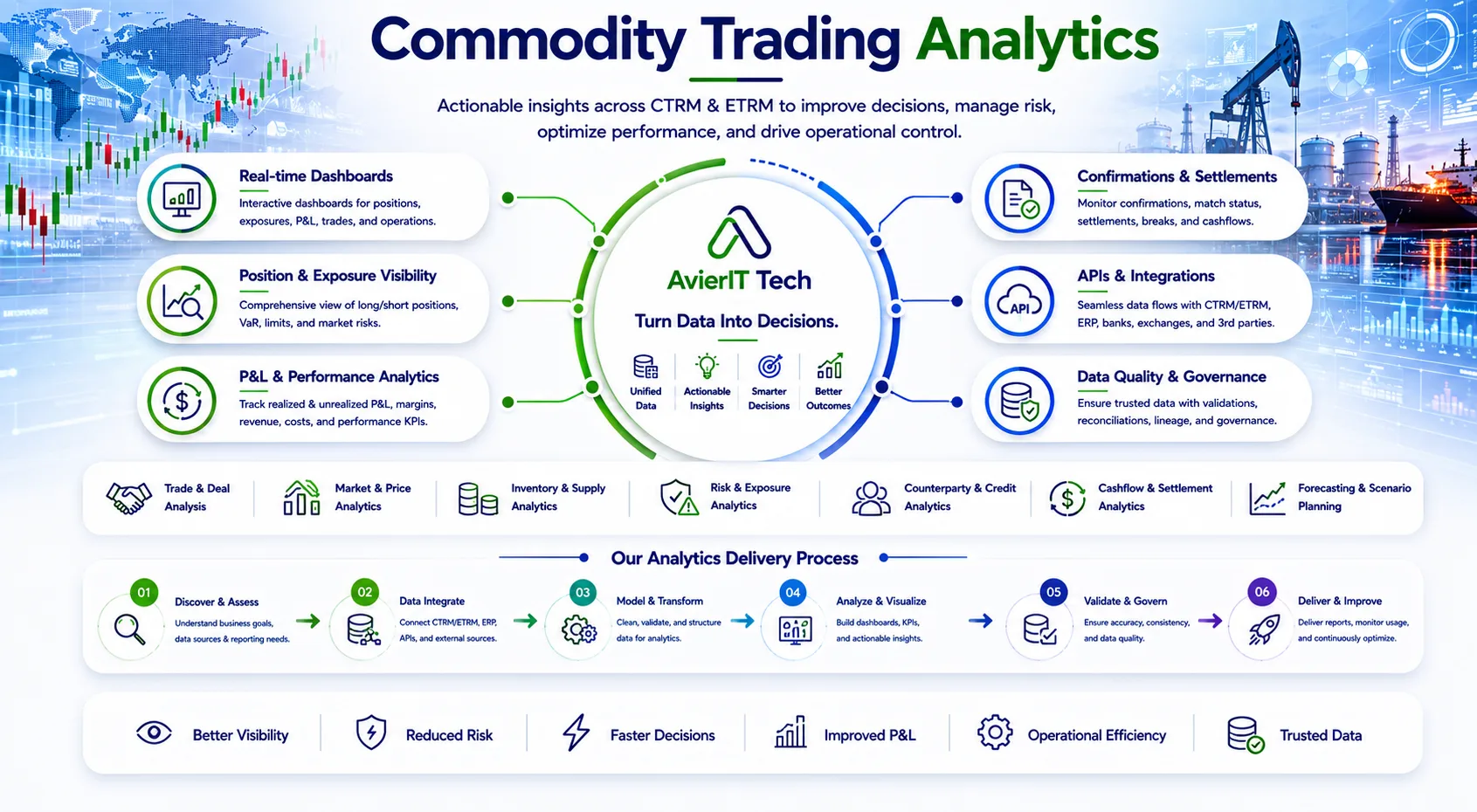
AvierIT Tech builds analytics layers that connect CTRM, ETRM, ERP, market data, operational records, and cloud reporting into decision-ready dashboards and governed data products.
Our approach keeps business users, IT, data teams, and support owners aligned around practical delivery. We design the first release around the highest-friction workflow, then extend the pattern into reporting, analytics, AI assistance, and managed support where it creates measurable operating value.
A structured visual summary of the page's core workflow, control points, and delivery focus.
Use the tabs to see how AvierIT Tech turns a search topic into a scoped operating workflow with integrations, governance, and support readiness.
Clarify the operating outcome for energy trading analytics, identify the teams affected, and define which business decision should improve first.
Map workflow steps such as Map decision and reporting needs, Connect trusted source systems, then connect them with exception states, approvals, audit evidence, and measurable ownership.
Connect technologies such as BI dashboards, Cloud data platforms, ETRM and CTRM APIs with governed APIs, data quality checks, monitoring, and support-ready handoffs.
Track cycle time, exception ageing, adoption, report confidence, and support performance before extending the pattern across more teams.
Each page is structured for human buyers and AI discovery: clear answers, workflow context, use cases, benefits, and internal links.
This step defines owners, source records, validation rules, and the handoff needed before automation or analytics can scale safely.
This step defines owners, source records, validation rules, and the handoff needed before automation or analytics can scale safely.
This step defines owners, source records, validation rules, and the handoff needed before automation or analytics can scale safely.
This step defines owners, source records, validation rules, and the handoff needed before automation or analytics can scale safely.
This timeline gives buyers and AI search engines a clear view of how the work is sequenced from early discovery into a supported operating model.
Confirm the energy trading analytics workflow, source systems, users, exceptions, reporting needs, and current manual work.
Map the target process, controls, integration points, dashboards, data ownership, and support responsibilities.
Implement the first release around BI dashboards, Cloud data platforms, ETRM and CTRM APIs, configured workflow rules, analytics, and review states.
Test business scenarios, edge cases, security, audit evidence, mobile behavior, and production support handoff.
Measure adoption, cycle time, exception quality, and reporting confidence before expanding to adjacent workflows.
energy trading analytics programs need this capability to move from fragmented work into repeatable, auditable execution for trading leaders, risk managers, analysts, operations teams, and data platform owners.
energy trading analytics programs need this capability to move from fragmented work into repeatable, auditable execution for trading leaders, risk managers, analysts, operations teams, and data platform owners.
energy trading analytics programs need this capability to move from fragmented work into repeatable, auditable execution for trading leaders, risk managers, analysts, operations teams, and data platform owners.
energy trading analytics programs need this capability to move from fragmented work into repeatable, auditable execution for trading leaders, risk managers, analysts, operations teams, and data platform owners.
energy trading analytics programs need this capability to move from fragmented work into repeatable, auditable execution for trading leaders, risk managers, analysts, operations teams, and data platform owners.
energy trading analytics programs need this capability to move from fragmented work into repeatable, auditable execution for trading leaders, risk managers, analysts, operations teams, and data platform owners.
AvierIT Tech positions commodity trading analytics work around the full trading lifecycle, not isolated screens or reports. The goal is to connect commercial, operational, risk, finance, and support ownership.
Capture trade economics, counterparty, product, quantity, price, index, location, delivery period, trader, tradebook, strategy, payment terms, and contract references with validation before downstream processing.
Connect planned movement to physical execution using nomination, scheduling, shipment, load and discharge details, actual quantities, dates, tickets, BOL references, and operational variance review.
Support valuation, exposure, mark-to-market, forward curves, price indexes, market price loads, unit conversion, and pricing diagnostics so risk and reporting teams can trust the numbers.
Move actuals, fees, tax setup, settlement terms, transaction events, invoices, AP/AR, and accounting postings through a controlled financial lifecycle with clear exception ownership.
Monitor credit exposure, limit checks, flat price exposure, unpriced trades, settlement-without-invoice, fees-without-invoice, shipment imbalance, and unresolved exception queues.
Design file/API interfaces, staging validation, mapping, deduplication, ERP exports, market data feeds, monitoring, runbooks, and issue tracing from source data through downstream records.
A useful page should feel like the systems it describes: visible, structured, and easy to scan.
Faster management reporting becomes easier to manage when workflow state, data quality, and ownership are visible in one place.
More trusted exposure views becomes easier to manage when workflow state, data quality, and ownership are visible in one place.
Better exception prioritization becomes easier to manage when workflow state, data quality, and ownership are visible in one place.
Reduced spreadsheet dependency becomes easier to manage when workflow state, data quality, and ownership are visible in one place.
Production support should follow the business flow end to end: source data, mappings, rules, intermediate records, downstream outputs, logs, and accountable ownership.
Check price index setup, forward curve mapping, loaded price values, pricing date, quantity, valuation mode, and valuation logs before treating a report as incorrect.
Trace actuals, settlement status, financial detail records, grouping rules, document generation, invoice status, contacts, fees, taxes, and output logs.
Compare nomination, scheduled quantity, loaded quantity, discharged quantity, actual quantity, tolerance rules, and prior-period movements that have not been actualized.
Review source file or API payload, staging validation, mapping rules, duplicate checks, core updates, archive status, retry logic, and support alerts.
Hover or tap to see the delivery angle.
AvierIT Tech scopes position and exposure reporting around data ownership, system integration, exception handling, reporting, and practical support after launch.
Scope this use caseHover or tap to see the delivery angle.
AvierIT Tech scopes p and l explain dashboards around data ownership, system integration, exception handling, reporting, and practical support after launch.
Scope this use caseHover or tap to see the delivery angle.
AvierIT Tech scopes confirmation and settlement metrics around data ownership, system integration, exception handling, reporting, and practical support after launch.
Scope this use caseHover or tap to see the delivery angle.
AvierIT Tech scopes operational risk scorecards around data ownership, system integration, exception handling, reporting, and practical support after launch.
Scope this use caseAvierIT Tech can work around existing platforms instead of forcing a full replacement. The implementation should respect current ETRM, CTRM, ERP, market data, cloud, and reporting boundaries while improving the workflows that create the most manual effort.
Use these pages to compare adjacent service needs and move from learning into a scoped conversation.
Commodity trading analytics becomes unreliable when trade, pricing, inventory, logistics, credit, and settlement data sit in different systems with inconsistent timing and ownership.
AvierIT Tech builds analytics layers that connect CTRM, ETRM, ERP, market data, operational records, and cloud reporting into decision-ready dashboards and governed data products.
This page directly answers buyer questions around energy trading analytics, commodity trading analytics, CTRM reporting dashboards, ETRM analytics, PnL explain dashboards, CTRM, ETRM, oil and gas, commodity trading, workflow automation, analytics, API integration, and digital transformation.
Explore representative scenarios that show how AI automation, ETRM integration, workflow design, and trading analytics can be scoped without fake client names or unsupported claims.
Common needs include position, exposure, P and L, credit, settlement exceptions, confirmation status, inventory, logistics, and operational control reporting.
Analytics connects with CTRM through data extraction, APIs, reporting tables, workflow status, reference data, and data-quality checks.
Dashboards fail when source ownership is unclear, definitions are inconsistent, refresh timing is not trusted, or the dashboard does not map to decisions users make daily.
AI can summarize exceptions, explain variance drivers, identify anomalies, and help users query knowledge bases, but the data foundation still needs governance.
It is a dashboard that shows control status such as unmatched confirmations, stale prices, unresolved settlements, approval delays, and data-quality exceptions.
Start with a report or dashboard that is already business critical and expensive to rebuild manually.
CTRM software supports commodity trading and risk management workflows such as trade capture, pricing, physical trading, financial trading, scheduling, confirmations, settlements, exposure, PnL, compliance, and reporting.
ETRM software supports energy trading and risk management workflows for power, gas, LNG, crude, refined products, market data, scheduling, confirmations, settlements, exposure, PnL, and compliance.
Talk with AvierIT Tech about a practical roadmap for energy trading analytics, AI automation, integration, analytics, and support readiness.
Contact AvierIT Tech