Workflow Automation and AI Systems
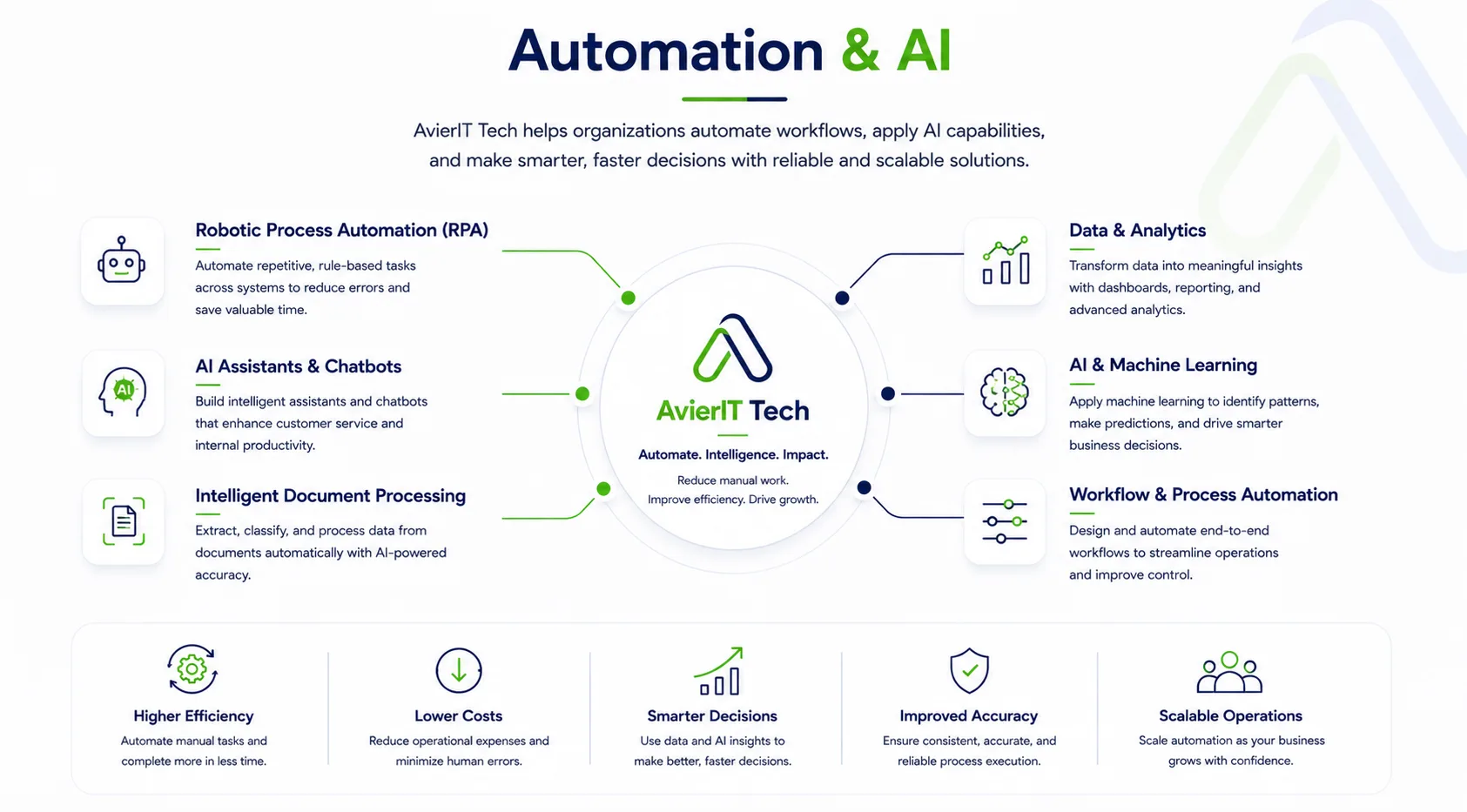
AvierIT Tech delivers AI automation services across workflow orchestration, RPA, copilots, document intelligence, and predictive decision support for operations teams.
We help teams reduce repetitive work, shorten response times, and improve accuracy by combining workflow automation, AI assistants, NLP, and generative AI into business processes.
Our automation programs connect naturally with service dashboards and core IT systems so process improvements are governed, usable, and measurable.
Automate Intelligently. Operate Efficiently.
Our automation engineers and AI consultants assess your existing workflows and identify tasks that can be enhanced with robotic process automation (RPA), smart decision engines, and conversational AI.
Talk to Our AI ExpertsAutomation and AI Service Diagram
A structured visual summary of the page's core workflow, control points, and delivery focus.
AI for the Future Scalable & Ethical Innovation
We design AI systems that are explainable, privacy first, and built to scale. Whether you're automating invoices or embedding machine learning into your product, we build responsibly.

Automate repetitive tasks with bots and scripts to free up valuable human effort and manual work.
Build smart chatbots, voice assistants, and NLP powered systems that understand your customers.
Use machine learning to forecast trends, optimize logistics, and personalize experiences.
Where We Apply Automation High Value Use Cases First
We focus on automation and AI opportunities that reduce repetitive work, improve decision quality, and create usable operational leverage instead of disconnected experiments.
Back Office and Operational Automation
We streamline repetitive workflows across finance, operations, support, and internal administration so teams spend less time chasing manual tasks and exception handling.
- Approvals, document processing, and data movement
- RPA, system triggers, and process orchestration
- SLA improvements and manual effort reduction
Copilots, Assistants, and Knowledge Workflows
We design AI powered experiences that help users find answers, generate drafts, summarize activity, and complete tasks with more consistency and less friction.
- Chat and agent interfaces for internal and customer use
- Knowledge retrieval, search, and content assistance
- Human in the loop review and escalation design
Analytics, Forecasting, and Intelligent Insights
When data quality and process maturity allow it, we add predictive and analytical capability that helps teams make better decisions and spot risk earlier.
- Classification, recommendations, and forecasting
- Operational dashboards and event driven alerts
- Model governance, validation, and KPI tracking
Automation Performance The Operational Signals Teams Want To Improve
Automation and AI initiatives create value when they remove repetitive effort, shorten response time, and give teams better decision support without reducing control or visibility.
Workflow automation reduces repetitive admin, routing, approvals, and handoffs so teams can focus on higher value exceptions and service quality.
Rule based orchestration, AI summarization, and event driven triggers help requests move without the queue delays common in manual operating models.
Dashboards, assistant interfaces, and AI driven insights help teams understand exceptions, trends, and performance drivers in time to act on them.
Automation Blueprint The Controls Behind Scalable AI Work
Useful automation requires clearer process selection, better integration planning, and a governance model that keeps AI outputs reviewable and fit for the business context.
Process Selection
We identify workflows with enough volume, repeatability, and business value to justify automation before tools are chosen.
Assistant Design
Copilots and AI agents are shaped around real user jobs, escalation rules, and knowledge sources rather than novelty alone.
Governance Controls
Approvals, audit trails, prompt boundaries, security reviews, and human checkpoints keep automated outputs dependable and explainable.
Continuous Tuning
Automation quality improves through usage review, exception analysis, and KPI tracking after the first release goes live.
Select
We prioritize the workflows and decisions where automation can reduce the most operational friction.
Design
We define triggers, data flows, exception paths, user touchpoints, and system integrations.
Govern
We add review points, security controls, logging, and oversight to keep automation usable and safe.
Optimize
We refine prompts, rules, workflows, and performance metrics based on operational feedback.
Automation FAQs How We Keep AI Work Practical and Controlled
Successful automation programs begin with the right process, the right data, and the right governance model.
- How do you identify the best workflows to automate first?
-
We look for high volume, rules based, error prone, or time sensitive workflows where automation can reduce manual effort and improve consistency without creating new operational risk.
- Can you work with generative AI as well as traditional automation?
-
Yes. We support RPA, workflow automation, integrations, conversational interfaces, and generative AI use cases. The right solution depends on the process, the quality of available data, and the level of oversight required.
- How do you handle governance, privacy, and human review?
-
We define approvals, auditability, fallback paths, data controls, and human in the loop checkpoints so automated outputs remain usable, explainable, and appropriate for the business context.
- Can automation projects connect with our existing ERP, CRM, or internal tools?
-
Yes. Most of our automation work involves existing systems. We design around APIs, data flows, permissions, and operational ownership so the automation actually fits the environment you already run.