commodity trading workflow automation case study
Low-competition case-study query supports high-value CTRM software development and trade automation services.
This page prioritizes low-competition, high-intent long-tail terms first, then supports broader commercial keywords with natural semantic coverage.
Low-competition case-study query supports high-value CTRM software development and trade automation services.
Business value: High. Trend: Evergreen workflow automation concern.
This page links back to the CTRM and ETRM pillar and across adjacent service pages to strengthen topical authority and help buyers compare the right next step. Semantic coverage includes commodity trading, energy trading, risk management, settlements, confirmations, scheduling, physical trading, financial trading, market data, trade lifecycle, pricing, PnL, exposure, compliance, integrations, APIs, and workflow automation.
Operations teams were using manual email follow-up to resolve trade amendments, confirmation breaks, settlement issues, and reporting questions.
Workflow triage, task ownership, status dashboards, automation rules, and controlled human approvals.
This representative case study avoids fake client names and focuses on the operating patterns AvierIT Tech would validate during discovery.
The scenario starts with a visible operational break: Operations teams were using manual email follow-up to resolve trade amendments, confirmation breaks, settlement issues, and reporting questions. Teams need a controlled path that reduces manual investigation without hiding accountability.
Trading and operations teams need consistent source records, controlled reference data, clear exception states, and traceable evidence before automation can be trusted.
A sustainable implementation should include monitoring, ownership, runbooks, training, escalation paths, and reporting so the workflow remains dependable after go-live.
A structured visual summary of the page's core workflow, control points, and delivery focus.
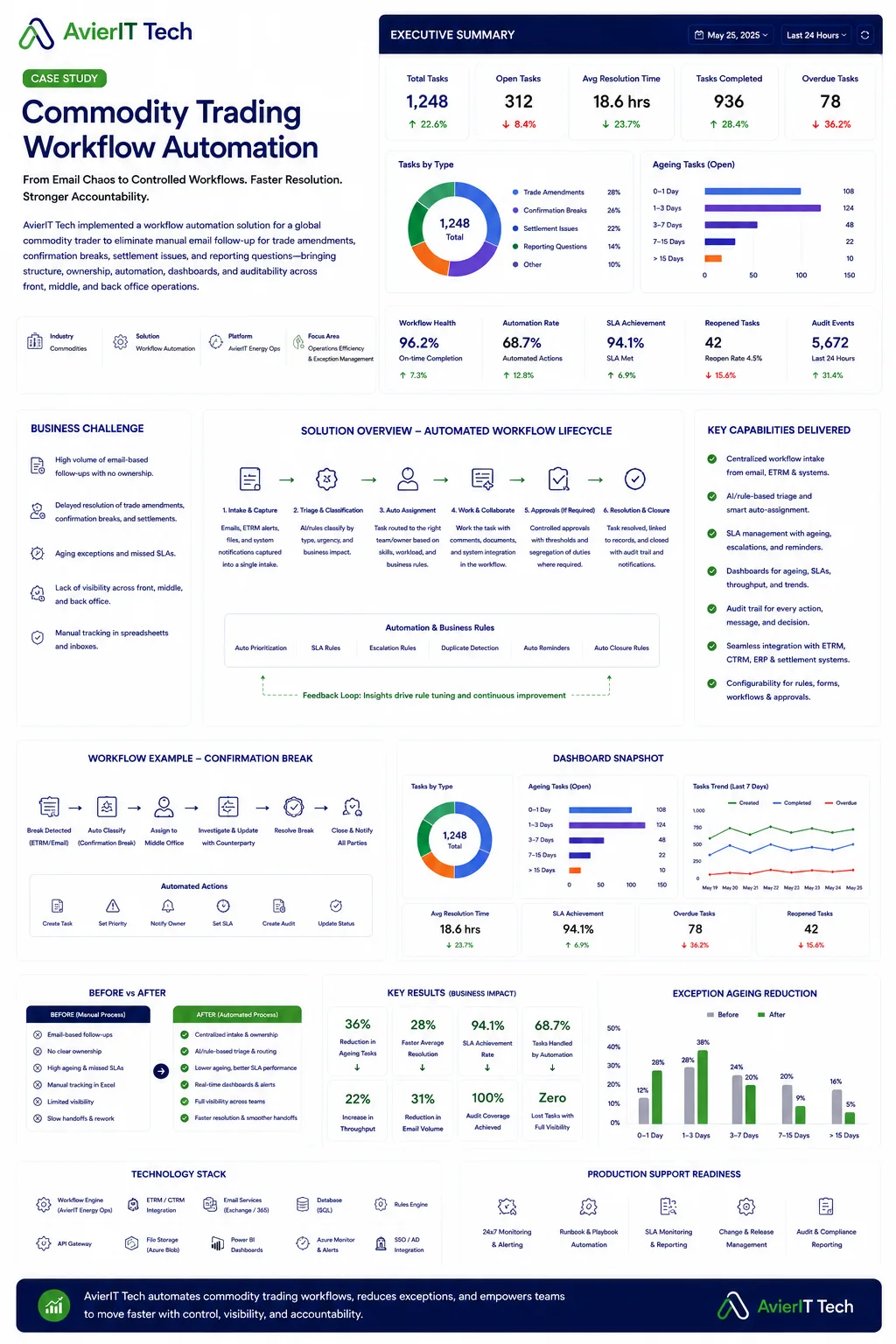
This representative case study is framed around real Commodity Trading Automation operating controls without using client names or unsupported production claims.
Capture trade economics, counterparty, product, quantity, price, index, location, delivery period, trader, tradebook, strategy, payment terms, and contract references with validation before downstream processing.
Connect planned movement to physical execution using nomination, scheduling, shipment, load and discharge details, actual quantities, dates, tickets, BOL references, and operational variance review.
Support valuation, exposure, mark-to-market, forward curves, price indexes, market price loads, unit conversion, and pricing diagnostics so risk and reporting teams can trust the numbers.
Move actuals, fees, tax setup, settlement terms, transaction events, invoices, AP/AR, and accounting postings through a controlled financial lifecycle with clear exception ownership.
Monitor credit exposure, limit checks, flat price exposure, unpriced trades, settlement-without-invoice, fees-without-invoice, shipment imbalance, and unresolved exception queues.
Design file/API interfaces, staging validation, mapping, deduplication, ERP exports, market data feeds, monitoring, runbooks, and issue tracing from source data through downstream records.
Operations teams were using manual email follow-up to resolve trade amendments, confirmation breaks, settlement issues, and reporting questions.
Workflow triage, task ownership, status dashboards, automation rules, and controlled human approvals.
CTRM/ETRM records, workflow engine, notification layer, document store, exception dashboard, and audit history.
Use illustrative ranges for planning, then replace them with real baselines once discovery confirms current cycle time, effort, quality, and adoption.
CTRM/ETRM records, workflow engine, notification layer, document store, exception dashboard, and audit history.
The exact release plan depends on the current systems, data quality, user groups, and compliance needs, but most delivery paths follow these stages.
Confirm users, source systems, current cycle times, exception volumes, evidence requirements, and the first workflow slice.
Map target states, integration points, data validation rules, approval paths, dashboards, and operating controls.
Configure the workflow around Workflow automation, CTRM, ETRM, using API-first integration and practical automation patterns.
Test normal cases, edge cases, breaks, retry paths, security roles, audit logs, reporting, and support handoff.
Measure adoption and quality, then extend the same pattern to adjacent CTRM, ETRM, analytics, and automation workflows.
Use this timeline as a practical discussion model for delivery planning, support readiness, and measurable operating impact.
Confirm users, source systems, current cycle times, exception volumes, evidence requirements, and the first workflow slice.
Map target states, integration points, data validation rules, approval paths, dashboards, and operating controls.
Configure the workflow around Workflow automation, CTRM, ETRM, using API-first integration and practical automation patterns.
Test normal cases, edge cases, breaks, retry paths, security roles, audit logs, reporting, and support handoff.
Measure adoption and quality, then extend the same pattern to adjacent CTRM, ETRM, analytics, and automation workflows.
Good CTRM, ETRM, AI automation, and analytics work needs operating controls as much as it needs technical build quality.
Validation rules, mappings, required fields, reference-data checks, duplicate handling, and reconciliation reports.
Queue ownership, ageing rules, approvals, exception categories, comments, evidence capture, and escalation triggers.
Access roles, API monitoring, environment promotion, deployment notes, rollback planning, and support runbooks.
Baseline metrics, target ranges, adoption reporting, quality checks, cycle-time tracking, and leadership dashboards.
Production support should follow the business flow end to end: source data, mappings, rules, intermediate records, downstream outputs, logs, and accountable ownership.
Check price index setup, forward curve mapping, loaded price values, pricing date, quantity, valuation mode, and valuation logs before treating a report as incorrect.
Trace actuals, settlement status, financial detail records, grouping rules, document generation, invoice status, contacts, fees, taxes, and output logs.
Compare nomination, scheduled quantity, loaded quantity, discharged quantity, actual quantity, tolerance rules, and prior-period movements that have not been actualized.
Review source file or API payload, staging validation, mapping rules, duplicate checks, core updates, archive status, retry logic, and support alerts.
These are representative target ranges for planning and prioritization, not verified client claims.
Illustrative planning signal.
25-45% target reduction in unresolved ageing exceptions. This is a representative target range, not a verified client claim.
Discuss measurementIllustrative planning signal.
Clearer handoffs across front, middle, and back office. This is a representative target range, not a verified client claim.
Discuss measurementIllustrative planning signal.
Improved management visibility. This is a representative target range, not a verified client claim.
Discuss measurementUse this representative scenario alongside CTRM solutions, ETRM solutions, AI automation for energy trading, commodity trading analytics, and the related service page for this case.
CTRM software supports commodity trading and risk management workflows such as trade capture, pricing, physical trading, financial trading, scheduling, confirmations, settlements, exposure, PnL, compliance, and reporting.
ETRM software supports energy trading and risk management workflows for power, gas, LNG, crude, refined products, market data, scheduling, confirmations, settlements, exposure, PnL, and compliance.
AI helps commodity trading teams extract document terms, compare confirmations, classify exceptions, summarize evidence, monitor anomalies, and route workflow tasks while preserving human review.
Power confirmation matching compares external confirmation terms with internal ETRM or CTRM trade records, flags differences, and routes matched or mismatched items for audit-ready review.
Oil and gas companies can automate trade operations by connecting CTRM, ETRM, ERP, market data, documents, APIs, workflow queues, analytics, and exception ownership around high-volume breaks.
CTRM covers broader commodity trading and risk management, while ETRM focuses on energy trading and risk workflows such as power, gas, scheduling, market data, and energy settlements.
Endur and Allegro support energy trading by managing trade lifecycle, risk, scheduling, settlement, reporting, integrations, and platform-specific workflows depending on configuration and operating model.
AvierIT Tech can help scope a similar CTRM, ETRM, AI automation, integration, or analytics scenario for your operating environment.
Contact AvierIT Tech