
End to End Database Migration Services
Secure, Zero Downtime, Compliance Ready Data Migration. We handle the complexity of moving your mission critical data so you can focus on innovation.
Our End to End Database Migration Process
A proven, structured, and deeply technical approach designed to minimize risk and ensure data integrity, performance, and compliance at every stage.
Discovery & Assessment
A thorough inventory analysis of your existing database environment, including dependency mapping and performance baselining.
Technical Specifications:
- Schema analysis (tables, indexes, views, stored procedures).
- Data volume and growth rate projection.
- Workload profiling (read/write ratios, query patterns).
- Security and compliance requirements review.
Potential Challenges:
- Undocumented dependencies between applications and database.
- Legacy database versions with limited introspection tools.
- Identifying all sensitive data for compliance (PII, PCI).
Migration Strategy & Architecture
Detailed design of the target database schema, defining the migration approach (homogeneous/heterogeneous), and comprehensive rollback planning.
Technical Specifications:
- Target platform (cloud/on prem, specific database engine).
- Data type mapping and conversion rules.
- Index and partition strategy for performance.
- High availability and disaster recovery architecture.
Potential Challenges:
- Complex data type mismatches requiring custom scripts.
- Ensuring application compatibility with new database features.
- Designing a robust rollback plan for minimal data loss.
Pre Migration Preparation
Setting up the target environment, configuring network connectivity, and conducting exhaustive connectivity and performance tests.
Technical Specifications:
- Provisioning compute, storage, and network resources.
- Firewall rules, VPC peering, and private endpoint configuration.
- Database parameter group and security group setup.
- Load testing and benchmarking against baseline.
Potential Challenges:
- Network latency and throughput bottlenecks.
- Security policy enforcement across environments.
- Resource provisioning and scaling limitations.
Schema & Object Migration
Converting and migrating all database objects, including tables, indexes, views, functions, and stored procedures, followed by rigorous validation.
Technical Specifications:
- DDL (Data Definition Language) script generation and execution.
- Validation of object counts, definitions, and permissions.
- Refactoring of incompatible stored procedures/functions.
- Foreign key and constraint integrity checks.
Potential Challenges:
- Proprietary database features not supported in target.
- Complex PL/SQL or T SQL code requiring manual refactoring.
- Ensuring referential integrity across migrated schemas.
Data Migration Execution
Executing the bulk load of historical data and setting up Change Data Capture (CDC) for continuous synchronization to minimize downtime.
Technical Specifications:
- Data extraction methods (export/import, native tools, replication).
- ETL (Extract, Transform, Load) pipelines for data cleansing and transformation.
- CDC setup using logical replication or transaction logs.
- Monitoring data latency and throughput during sync.
Potential Challenges:
- Managing large data volumes and migration window constraints.
- Network interruptions affecting data transfer integrity.
- Ensuring transactional consistency during CDC.
Validation & Testing
Comprehensive data integrity checks, reconciliation, and performance testing to ensure the target database mirrors the source and meets performance SLAs.
Technical Specifications:
- Row count and checksum validation across source and target.
- Query execution time comparisons and stress testing.
- Application integration testing and user acceptance testing (UAT).
- Data quality and referential integrity checks.
Potential Challenges:
- Discrepancies in data type handling or character sets.
- Simulating peak production load for accurate performance testing.
- Coordinating UAT across multiple business units.
Cutover & Go Live
The final switchover, involving a brief outage (if any), final data synchronization, and redirecting application traffic to the new database.
Technical Specifications:
- Application shutdown and final CDC synchronization.
- DNS record updates and load balancer reconfigurations.
- Post cutover health checks and smoke tests.
- Rollback trigger conditions and procedures.
Potential Challenges:
- Unexpected application connection issues post switchover.
- Propagation delays in DNS changes.
- Coordinating cutover with minimal business impact.
Post Migration Optimization
Continuous monitoring, performance tuning, and comprehensive knowledge transfer to your team for ongoing operational excellence.
Technical Specifications:
- Establishing new monitoring and alerting dashboards.
- Ongoing query optimization and index tuning.
- Capacity planning and cost optimization strategies.
- Documentation and training for database administrators.
Potential Challenges:
- Unforeseen performance regressions with specific workloads.
- Adapting to new cloud native database features and best practices.
- Ensuring internal teams are fully equipped to manage the new environment.
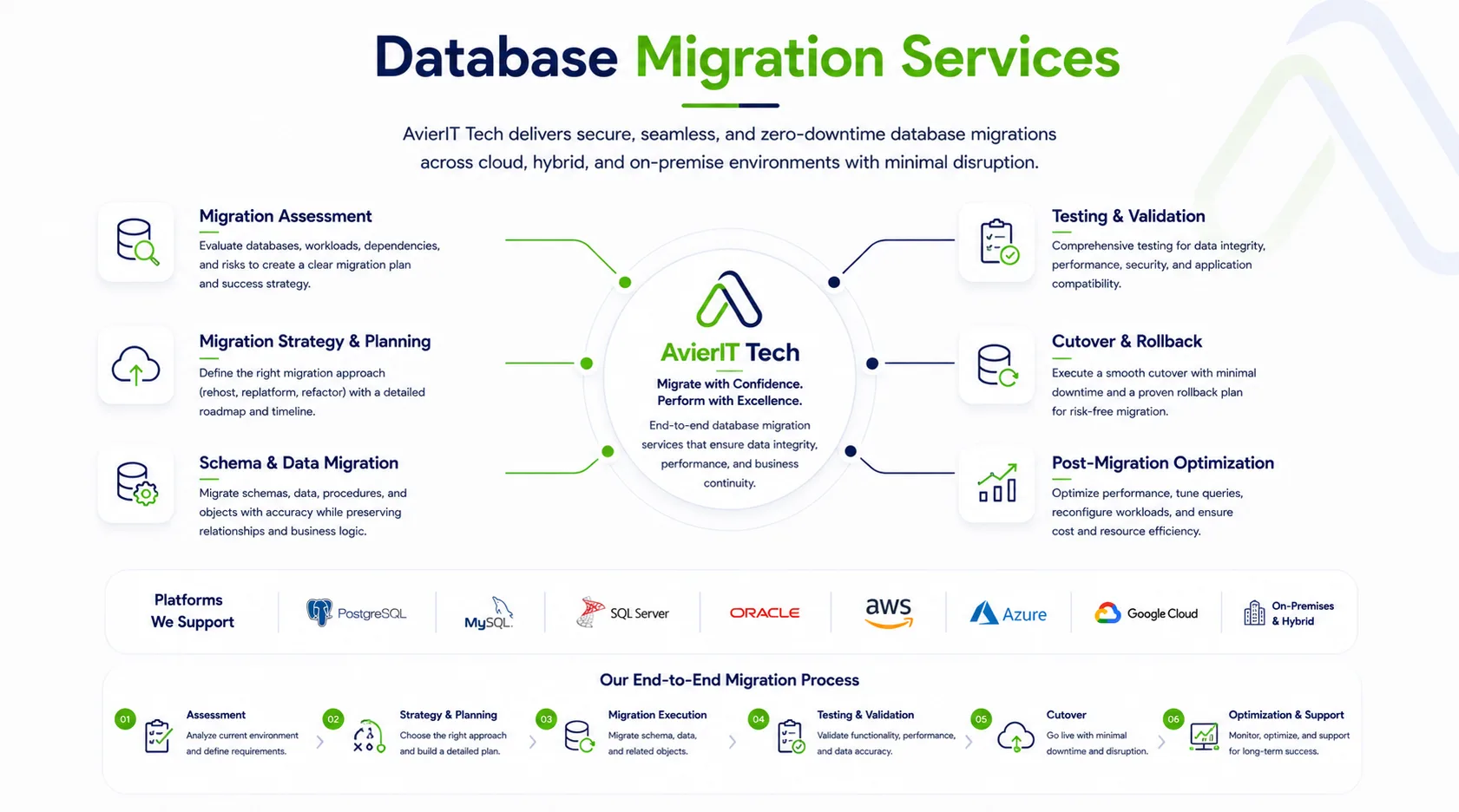
Visual Overview
Database Migration Services Diagram
A structured visual summary of the page's core workflow, control points, and delivery focus.
Zero Risk Assurance
We prioritize data safety above all else. Our protocols ensure your data is protected, backed up, and recoverable at every second of the migration.
Instant Rollback
Automated rollback procedures integrated into every pipeline stage.
Continuous Backups
Point in time recovery snapshots taken before and after key milestones.
Live Monitoring
Real time dashboards tracking latency, throughput, and error rates.
Compliance Checks
Automated PII detection and masking to maintain regulatory status.
Platforms & Technologies
Why Enterprises Trust Us
We don't just move data; we modernize your infrastructure. Our dedicated experts ensure a seamless transition that empowers your business.
-
check
Enterprise Grade Security
End to end encryption and private link connectivity.
-
check
Near Zero Downtime
Advanced CDC techniques to keep your business running during migration.
-
check
Dedicated Migration Experts
You get a dedicated squad of DBAs and architects, not a generalist IT team.
-
check
Compliance Ready
Full audit trails for GDPR, HIPAA, and SOC2 requirements.

Ready to migrate with confidence?
Schedule a free 30 minute consultation with a Senior Database Architect. No commitment required.
Talk to a Migration Expert arrow_forwardDatabase Migration Services, FAQs
What is database migration?
Database migration is the process of securely moving data, schemas, and database objects from one database platform to another, such as on premise to cloud or between cloud providers.
Can database migration be done with zero downtime?
Yes. AvierIT Tech uses Change Data Capture (CDC) and parallel replication strategies to ensure near zero or zero downtime during enterprise database migrations.
Which databases do you support?
We support PostgreSQL, MySQL, Oracle, SQL Server, MongoDB, Snowflake, and cloud platforms including AWS, Azure, and Google Cloud.
How long does a database migration take?
Migration timelines depend on data volume, complexity, and compliance needs. Most enterprise migrations take between a few days to several weeks.
Is database migration secure?
Yes. We follow SOC2, GDPR, and ISO 27001 compliant security practices including encryption, access control, and audit logging.
Get a Free Database Migration Assessment
Speak directly with a Senior Database Architect. No sales pressure. 100% confidential.